Attention All Downton Abbey Fans… DM Drama may be coming to the Castle!

As a passionate Diabetes MSL for Novo Nordisk, I am blessed to be assigned the mission of covering the majority of the DSME Programs and Endo Offices in my friendly state of South Carolina. And just like you AADE members- I love my job, and consider it the highest honor to work in the field of diabetes in order to help detect, treat, and one day to cure this horrible disease which affects 1/8 adults in our state.
Now, it is not that I don’t enjoy my chosen profession, but on Sundays I do have a few diversions that take me away from the business travel, medical office appointments, and laborious reading on clinical studies that are the core of my weekday routine for my job.
One such diversion, on Sunday evenings, is to indulge in my total obsession of the life of the wealthy Crawley Family, who resides at Downton Abbey and on PBS every Sunday night at 9pm. I know from attending multitudes of LNG meetings throughout the South, that indeed, this is a hot topic for many of us AADE members. We love to go back in time to the High Society Era of the 1920’s, with all its graces and extravagances of living in a mansion with personal servants, butlers & ladies maids, and nightly formal dinners set up with exquisite crystal stemware and ornate silver flatware…. Oh yes- to be a rich landowner at Downton Abbey back in 1920 was to surround oneself with a pampering and luxurious lifestyle….
So what could possibly upset the tranquil life at the Abbey? How about a news release from the JDRF (Juvenile Diabetes Research Foundation)! JDRF just announced this week that the producers of Downton Abbey are considering adding a new character who will have (yes- you guessed it) DIABETES!
https://www.jdrf.org.uk/news/latest-news/character-with-type-1-diabetes-to-feature-in-downton-abbey
Goodness Gracious! I could hardly contain myself with this newsflash- my two favorite passions (Diabetes & Downton) are about to be combined, but surely not without a lot of drama and dismay over how to care for T1DM back in the days when insulin was only first being discovered and manufactured. This new twist in the story line promises to be the most fascinating of all, as it will capture us up into the life of the person with T1DM, back in the time period when the diagnosis of DM automatically led to a slow and painful death via the inevitable DKA induced starvation and coma.
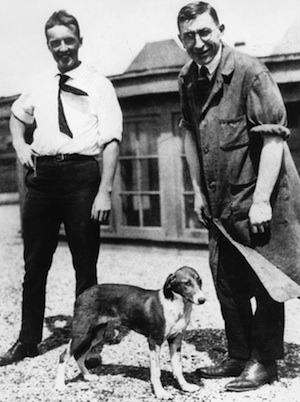
Left Photo: Dr. Banting, right, and Dr. Best, left, with one of the diabetic dogs used in experiments with insulin in early 1920. (Credits: University of Toronto Archives)
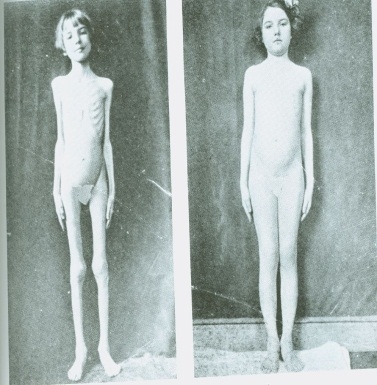
Right Photo: 11 Year Old T1DM before and then after insulin was discovered and provided to child in 1922.
We have certainly come a long way since 1921, when insulin was first extracted and researched by Doctors Banting and Best in Toronto, Canada. I am reminded of our heroic early insulin pioneers and scientists, and how hard they endeavored in the discovery of insulin- working long hours and pressing on through the trials and tribulations in the primitive animal research labs. They creatively managed multitudes of set-backs on both extracting animal insulin for the studies, purifying this insulin for less autoimmune reactions, and later developing insulin production, storage and injection techniques for use in humans. These early scientists took insulin therapy from the preclinical testing in dogs (like Marjory in the photo above), to testing in champions early diabetes patients such as 3 year old JT and Elizabeth Hughes.
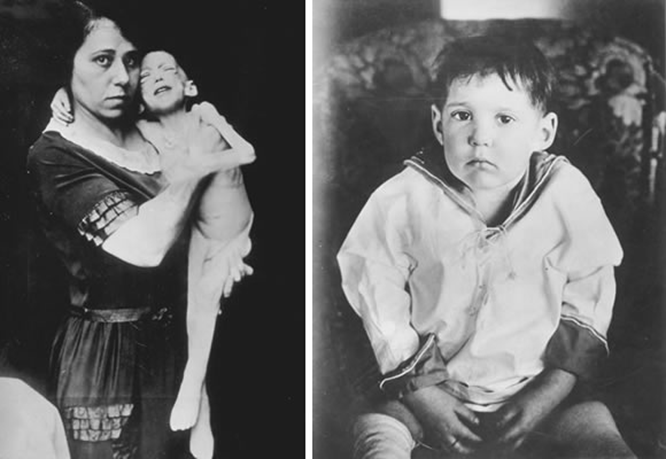
Picture: 3 year old JT before insulin and then 2 months later after he started insulin therapy.
In fact, if anyone has not had a chance to read the history of insulin development- put these two phenomenal books on your summer reading list for 2014:
- The Discovery of Insulin – by Michael Bliss
- Diabetes and Denmark – edited by Christian Binder , Torsten Deckert and Jorn Nerup
Did you know that because the discovery of insulin was such a life-saving and humanitarian breakthrough for people with diabetes, the patent for this amazing new drug, INSULIN, was given away at no charge to 2 pharmaceutical manufacturers with the very firm, and yet amazingly humanitarian directions to go forth and make enough of this new life saving hormone for all patients with diabetes who need it throughout the world. What an amazing thing- to not even charge for the patent of such a hugely important drug, but to assign two pharmaceutical companies the task of sharing the magical recipe for making exogenous insulin with all the patients, so that they could be saved from an inevitable slow and painful DKA death.
Of course- as a CDE and Diabetes Educator you probably know what happened next in the insulin manufacturing mini-series … Eli Lilly based in Indianapolis was given the patent for producing insulin on the North American continent (for the US, Canada, and Mexico). And Novo Nordisk of Denmark was given the marching orders to produce and supply the other 6 continents of the world with an ample supply of insulin therapy including all the countries within Europe, Asia, Africa, South America, Australia, and Antarctica. Now, I’m not sure how many Novo Nordisk MSLs and Sales people have been needed in Antarctica to date, but rest assured, if insulin is needed- because of Doctor Banting’s and Best’s orders to share this life saving drug with the world, there is a global plan for all patients to get their insulin anywhere in the world!
So, how did 1920’s England, back in the era of Downton Abbey, teach about insulin therapy, SMBG, CHO Counting, Foot care, Prevention of Micro- Vascular diseases, etc? Well, we know that the Diabetes Educators in the 1920’s probably did the best they could in their medical clinics, but they certainly were not privy to our current standards of practice recommendations and the Diabetes Care ADA Guidelines we possess today in 2014. Won’t it be interesting to see how the clinics of this era manage the disease, and how the patients will utilize this new experimental drug, called insulin, to cheat newly diagnosed patients from an early death? So stay tuned, Downtown Abbey fans to the “Diabetes Downton Drama” we hope will happen later this season.
And yet in the meantime- let’s all take care to review our new 2014 ADA Guidelines on T1DM. By now, you have probably already seen the new bullets on how to treat newly diagnosed T1DM. The major clinical pearls I have taken away are to:
- Get first degree relatives of T1DM patients screened for T1DM risk in the setting of a clinical research study. More and more research centers are available in SC to help provide at risk family members with the tools to screen their other children and family members for some of the autoimmune risk factors that lead to pancreatic beta-cell burn out. And if caught early, there is much that can be done to protect the few remaining beta-cells, or to stop the immune attack on the pancreas. So in South Carolina- please connect with your local Peds Endo Office or the associated academic center (MUSC, USC, or GHS) for assistance. Remember that early diagnosis of T1DM will help limit complications and extend long term insulin production in patients.
- Additionally, the 2014 ADA Guidelines and other recent publications in Diabetologia, encourage all patients with known T1DM to consider participating in clinical trials for T1DM. We now know, that even with long-term duration of T1DM, the pancreas will still have some residual or functioning beta cells that can possibly be “re-activated”. The new study in Diabetologia by Oram and colleagues shows that a large fraction of patients with long-standing T1DM have a low-level, but persistent functioning of islet cells even up to 30 years after their initial diagnosis of DM. With new technology available including more sensitive C-peptide assays, and new clinical research programs aimed at preserving the residual beta-cells that remain after such a diagnosis, there may be even more scientific advances and hopes for our patients in SC diagnosed with T1DM if they get involved in clinical research early upon their diagnosis.
So, let’s all stay tuned to Downton Abby and relish in the improvements in clinical knowledge and treatments that are now an everyday part of educating our patients with T1DM in 2014. And let’s also be on the lookout for the upcoming advances that may be available to our patients if we link up with clinical trial sites and assist in exploring new treatment opportunities for our patients newly diagnosed with diabetes. The future for improvements in diabetes education and treatment is boundless! .
Warm Regards,
Carolyn Bethea, MS, RD, BC-ADM, CDE, CDTC
*If you are interested in more details or a presentation for your professional group on the latest ADA Diabetes Clinical Practice Recommendations for 2014, please connect with Carolyn at caob@novonordisk.com or 609-902-5821
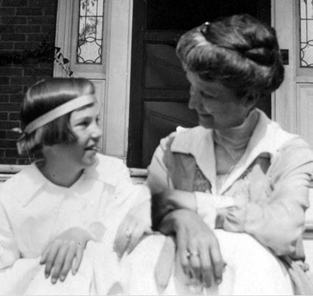

Pictures: Top left: Miss Elizabeth Hughes, age 12 and one of the first pts treated with insulin therapy in 1922.
Top Right: Original Novo Nordisk Insulin and pen device.
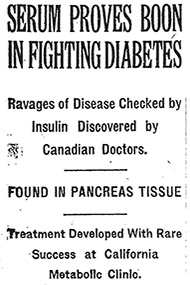
Below: Newspaper article announcing breakthrough of insulin discovery, calling it a “serum”